I already dealt with the status of the WWW in the recent past. See, specifically, the authoritative opinion of Sir Tim Berners-Lee on that. Multiple dynamics have upset the initial idea of a distributed, democratic, and influential worldwide system, as conceived in the 90s, including the roles of BigCorps, socials, and geopolitics. What appears to be the last brick in the grave of the WWW is the current AI wave, which introduces two distinct elements of breaking an already compromised equilibrium.
It is now evident that a large part of the WWW content is AI-generated [3,4], often with very low quality and care. Let me point out, for instance, articles in the well-known Medium.com magazine (but that’s not specifically a problem of it, it is a general one): it is not a novelty that quite a lot of authors there are intensively writing most of their content via AI, with just minor human contributions. This is not new: in the past, the figure of the ghostwriter (who wrote slop contents by weight) was quite widespread and even present in prime-time magazines, but now AI tooling has exacerbated this approach. This is what is generally considered the enshittification of the web, and it started even before the AI hype, with content generated by extensive copy-and-paste and the addition of announcements, clickbait titles, sponsored articles, etc.
At the same time, the web search systems are also undergoing significant changes. Google introduced AI overviews, but people also changed their approach to searching for information, and that was not dependent on Google's or any other search engine's suggested overview. The possibility of having a structured summary of any argument, instead of a long list of well (or not so well) centered references, changed many people's views of the whole information search topic. Unfortunately, this also deeply impacts the overall sense of sponsoring a search engine or maintaining a site of content about any topic. For instance, why maintain a whole site about tourism in Berlin if the same information can be obtained in a short form via AI independently, and no one will visit such a site? And above all, how will content creators continue to monetize effectively in such conditions [1]?
If, as seems likely after Google I/O 2026, the next search engines will be simply AI overviews, mainly with sponsored results (typically by secretely steering AI summaries), what about independent and non-profit content? To be clear, already most traffic (I mean >90%) on small websites is bot-generated. Of course, that includes AI bots and general crawlers. The duration of such visits is typically under a few seconds. Of course, such a status is not a big problem for non-profit sites, but it can cause some frustration. That was true also before the autumn of 2022, indeed. What will be the final result of such a process is quite evident to me: the enshittificated, mechanical production of web content will go away because it will become only noise on the net, without any real revenues (or value); as it has started, it will surely go mostly to a dead end. Of course, until it can still capture a fraction of users' attention, it will stay here, but in my opinion, it will only be a matter of time before such low-profile content ends. What will remain is probably paywalled or institutional pages (only those with a decent value per se), non-profit/community websites, and AI-protected sites (with a continuous risk of abuse by new generations of autobots). Free access with announcements will become a thing of the past, as the number of active human readers declines. Mass production and poetry, to summarize.
Surely, easy monetization and SEO will soon be a keepsake. It has also been visible for ages in alternative media (such as video-based content), which is currently much less accessible to AI generation solutions. Even in such a domain, content creation has become more selective, and valuable assets are quite distinct from a more general, low-quality production. My idea is that, in the long run, most content creation (in any format, text, audio, or video) will follow a bimodal distribution (with low and high quality peaks) around its general quality, and the best quality will generally require some form of subscription, because of the involved efforts for production. Indeed, I would expect some concentration among a relatively few actors for any topics. Quality is neither spread nor democratic. One will need to exit the mass of low-quality profiles, which are and will be the majority of what is available out there on the web.
That’s already visible in the traditional mainstream media: most of their web-based content is pure garbage, and that was true even a few years ago; now it's paroxysmal. I found years ago that most of the so-called news on mobile devices was largely disseminated through announcements, dialogs, and sponsored content, making it completely unusable and unfocused, for me. Nevertheless, the mobile-first approach has already been the dominant UX for the average user for ages. Even the AI-generated content could largely become targeted to AI bots instead of humans, with unclear implications about readability and form. But the average user gets used to the most incomprehensible things, so who knows?
Therefore, the concrete perspective (or the crude reality) is a web full of AI-generated content or walled gardens, with few non-profit corners that publish mainly for fun, along with a few authoritative sources (such as Wikipedia [2], a knowledge source that will need to be defended and encouraged as well), which are becoming increasingly difficult to discover in the old way by humans.
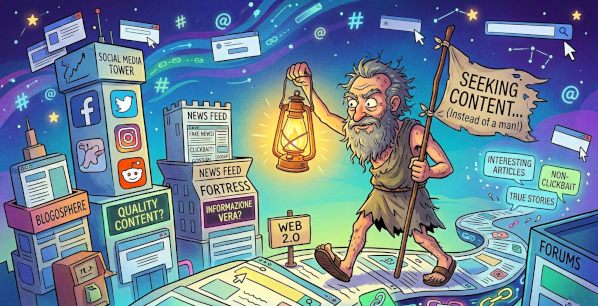
We all become like modern Diogenes walking with a lantern on the net, during the daylight, looking for the true web value with mixed luck...
A giant step backward at a time when there were manually maintained indexes of interesting sites organized by topics. Damn it, sounds familiar. Not so bad, wasn’t it? That’s the core of the Fediverse, basically: some micro-universes oriented to small communities of focused users, all navigating in a global ocean of mere s*t.
References
- https://social.vivaldi.net/@everton137/116613317111584835
- https://www.cnbc.com/2026/01/15/wikipedia-amazon-meta-perplexity-ai.html
- https://www.forbes.com/sites/torconstantino/2025/04/14/the-60-problem---how-ai-search-is-draining-your-traffic/
- https://www.techradar.com/ai-platforms-assistants/the-internet-is-now-mostly-written-by-machines-study-finds
For comments, join the discussion on Mastodon.