A few days ago, on Mozilla’s blog, a brief article entitled
An open letter to every family’s designated IT support
was posted. What appeared as a joke is indeed the reality of any micro-community around the globe, from families to
small offices and any small-scale groups of individuals glued together. The
designated IT support is the most widespread form of IT support. Yes, usually
(s)he is the most competent among members of such informal groups, though not
competent in absolute terms. Often, a one-eyed (wo)man in the land of the blind
is king, says a proverb here.
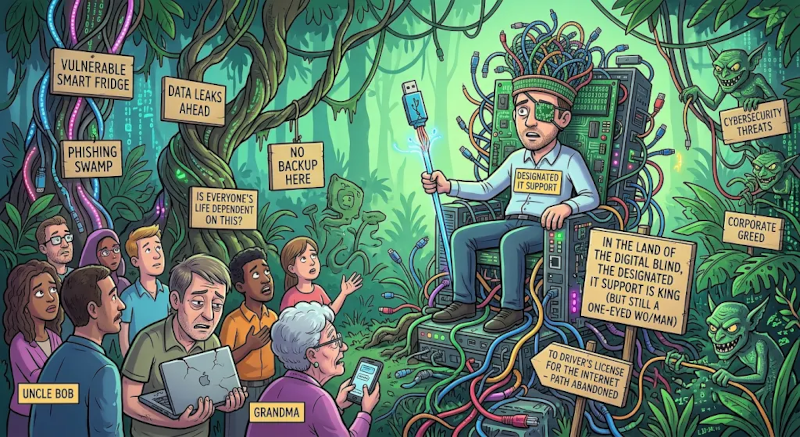
Often, a single person (no backup intended) in such small worlds becomes the group's IT center of competence, with predictable consequences when efforts need to scale up.
While this is annoying (for the designated IT support victim/person) but manageable at the family level, this is a problem today at the mid-range level, because IT services and the number of non-personal devices connected to the Internet haven't scaled with that one person. Who could have imagined a few years ago that even a small business shop network would need professional IT support to manage fridges properly and avoid remote exploitation, as happened recently worldwide?
I know these realities perfectly well: an external support team installs a certain number of smart devices with remote control, delegates updates informally to Mr. Nobody, and does not even apply minimal security measures (such as password diversification and rotation, or firewall filters, to name the most obvious). What is clearly missing is any minimal security information and training for the workers whose jobs are completely different and are not interested at all in proper infrastructure maintenance. The disaster is ensured later on.
A few days ago, 3700 schools in Italy received the same bomb alert via a scam email from the Philippines by an improbable Mr. Andropov: more than 70 of them evacuated, some not just because the anti-spam filter worked. Schools, at the same time, often have no technical staff and no IT support at all, but for some designated IT expert, chosen among guys who understand about computers.
The point is: is it nowadays conceivable that the security of digital processes is delegated to Mr. Nobody? Or that the average worker is launched into digital workflows without basic periodic security training? When and how will schools, shops, and micro/small companies understand that digital processes are now structural parts of the core business of any production reality, not a necessary evil to tolerate and barely understand?
In our lives, networks, services, and digital processes are fully part of life, but for some reason, most people still treat them as a big mystery, as if their own lives didn't depend on them. That’s also why data are seen as low-value assets and given away for free to any social media company, with very low barriers to accepting conditions . The data leaks that happen from time to time for personal data are the icing on the cake, often stolen to be used to apply social engineering techniques at the expense of unsuspecting users all around the world. Many people lack basic training in digital self-defense, like children abandoned in a tropical forest.
Is it too much to expect that, instead of waiting for so-called designated IT support, each person learns the basics of security and digital awareness to defend themselves in today's information jungle, for cybersecurity threats as well as companies' greed and abuse? The first defense line is your old uncle and grandmother, like them or not. We introduced driver's licenses at the end of the 19th century, but we still struggle to admit that the modern digital world requires the same level of awareness and skills to avoid accidents. As for vaccinations, security infections target the weakest link; prevention also requires training for all users in this digital world, so they're prepared to live in it and protect the weakest members of the community.
For comments, join the discussion on Mastodon.